
Durga Puja in Jaipur (2026)
eventSeptember / October — major days are Saptami, Ashtami, Navami, Dashamilocation_onJaipur, RajasthanAlso known as: Sharodotsav • Navaratri (Bengal) • Durgotsav • Maha Puja
Vedic celebrations for Durga Puja 2026 in Jaipur, Rajasthan are determined by local sunrise, sunset, and Tithi timings calculated for geographical coordinates (26.91°N, 75.79°E).
auto_awesomeThe Essence
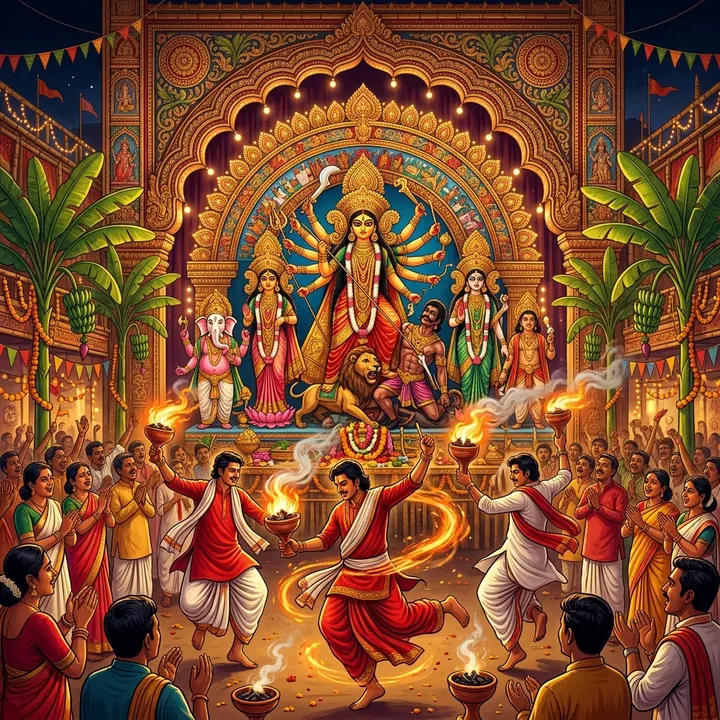
Durga Puja is the defining festival of Bengal — one of the world's great cultural events, inscribed on UNESCO's Representative List of Intangible Cultural Heritage of Humanity in 2021. For five days (Saptami to Dashami), the city of Kolkata transforms into the world's largest open-air art gallery: hundreds of elaborately themed pandals (temporary shrines) are constructed, each competing to outdo the others in scale, artistry, and ingenuity. Some recreate the Vatican, some the Taj Mahal, some comment on environmental issues, some depict abstract philosophical themes — all housing exquisite clay idols of Goddess Durga with her four children: Lakshmi, Saraswati, Ganesha, and Kartikeya. For Bengalis worldwide, Durga Puja is not merely a religious festival — it is their cultural soul.

History & Legends
The Birth of Durga — Gods Assemble Their Shakti
The demon Mahishasura had obtained a boon making him invincible against all men and gods. He conquered heaven and drove the gods out. In desperation, all the male gods combined their divine energy (Shakti) into a radiant, unconquerable female form — Goddess Durga, riding a lion. Each god gave their most powerful weapon: Shiva's trishul, Vishnu's chakra, Indra's vajra, Brahma's kamandal, Varuna's conch, Yama's staff. After a 9-day battle, Durga killed Mahishasura on the 10th day (Dashami). The nine days of battle are Navratri; the 10th day is Vijayadashami (Dussehra / Durga Puja Dashami).
Durga Puja in Bengal — The Homecoming Narrative
In Bengali tradition, Durga Puja has a distinctly family-centered emotional texture. Goddess Durga is not just the cosmic warrior — she is Uma, the daughter of the mountains (Parvata Raja and Menaka), who comes home to her parents for five days every autumn from her husband Shiva's home on Mount Kailash, accompanied by her four children. For Bengalis, the sight of the Durga pandal is the sight of a daughter coming home. The farewell on Dashami — Vijoya — when women apply sindoor and feed the goddess sweets before her immersion — is modeled on the farewell of a daughter returning to her marital home after a holiday visit. This family emotion is why Durga Puja in Bengal has an intimacy and nostalgia unmatched by any other festival's celebration anywhere in the world.
Spiritual Significance
Durga Puja affirms the supremacy of Shakti — divine feminine power — as the ultimate force in the universe. Theologically, the festival declares that when the cosmos itself is threatened, deliverance comes not from male power but from the unified feminine energy of all gods. Socially, Durga Puja is Bengal's great social equaliser: the pandal is open to all, the prasad is shared by all, and the evening streets where millions walk together is a democratic space unlike any other. The scale of community participation — thousands of volunteers in every neighbourhood, every household contributing to their para's (locality's) puja — expresses a concept of collective identity that is distinctly Bengali.

Regional Celebrations & Customs in Jaipur
Kolkata (The World Capital of Durga Puja)
The city hosts 2,500+ pandals, many with themes conceived a year in advance by ace set designers and artists. College Square, Kumartuli Park, Bagbazar, Sreebhumi, and Mohammad Ali Park draw the longest queues. Over 4 million people walk the streets on Ashtami and Navami nights. Kolkata Metro runs 24 hours all 5 days. The UNESCO recognition has drawn international tourists in recent years.
Kumartuli — The Artisans' Quarter
Kolkata's Kumartuli neighbourhood houses the skilled kumhars (potters) who create the clay idols year-round. The last few weeks before the puja see a frenzied finishing rush — thousands of idols in various stages of creation lining every lane. A Kumartuli visit before Durga Puja is one of Kolkata's most memorable experiences.
Other Bengal Cities & Diaspora
Durga Puja is celebrated with equal devotion in Howrah, Burdwan, Siliguri, and across Bangladesh (Dhaka, Chittagong). The Bengali diaspora in Delhi (CR Park), Mumbai, Chennai, and globally (New York, London, Tokyo) hold community pujas with genuine clay idols brought from Kolkata.
Agartala & Northeast India
Tripura's Agartala celebrates Durga Puja with a scale second only to Kolkata. With a large Bengali Hindu population, the city's pandals rival those of Kolkata in creativity. Udaipur's Tripura Sundari Temple is also a major pilgrimage point during Navratri.
The 5 Days of Celebration
- fiber_manual_recordShashthi (Day 1 — Goddess Arrives)The goddess's eyes are ritually unveiled in the Bodhon ceremony (awakening). The idol, transported to the pandal, is formally invoked. Kolkata streets begin to fill. The sound of dhak (large traditional drum) echoes everywhere.
- fiber_manual_recordSaptami (Day 2 — Main Puja Begins)Nine types of plants (Nabapatrika) are bathed and the goddess is formally installed. Anjali (offering of flowers) sessions begin, with thousands joining to throw flowers at the deity three times while chanting mantras. Pandal-hopping (visiting different pujas) starts in earnest.
- fiber_manual_recordAshtami (Day 3 — Most Sacred)The holiest day. Morning Pushpanjali sees the largest crowds. Kumari Puja — worship of a young pre-pubescent girl as a living goddess — is performed at many major pujas (most famously at Belur Math). Sandhi Puja at the junction of Ashtami and Navami is when lamps and incense are offered frenziedly for 48 minutes.
- fiber_manual_recordNavami (Day 4 — Final Full Day)The last full day of the goddess's visit. Homa (fire ritual) and Bali (symbolic or actual offering) are performed. Communities hold grand cultural programs: Rabindra Sangeet, classical dance, and folk performances. The sadness of imminent farewell hangs alongside the joy.
- fiber_manual_recordDashami (Day 5 — Visarjan)Vijayadashami — the emotional farewell. Married women (Shola Shringer) put sindoor on the goddess and feed her sweets in the Sindoor Khela ritual. The idol is carried in procession to the nearest river for immersion. Dhak drums, conch shells, and weeping fill the air. 'Asche bochor abar hobe' — she will come again next year.
Jaipur Quick Facts
| Date | September / October — major days are Saptami, Ashtami, Navami, Dashami |
|---|---|
| Tithi | Ashwin Shukla Saptami to Dashami — 5 main days within Navratri |
| Meaning | Annual homecoming of Goddess Durga — triumph over the buffalo demon Mahishasura |
| Location | Jaipur, Rajasthan |
| Deities | Goddess Durga (Mahishasuramardini — slayer of Mahishasura) Goddess Lakshmi Goddess Saraswati Lord Ganesha Kartikeya (Murugan) |
Share With Family & Friends
Share auspicious Durga Puja muhurat timings in Jaipur on WhatsApp.
Share on WhatsAppNever Miss The Date
Add Durga Puja to your device calendar for native notifications.