
Dussehra in Junagadh (2026)
eventOctober (10th day after Navratri ends)location_onJunagadh, GujaratAlso known as: Vijayadashami • Dashami • Navaratri concluding day • Ravan Dahan
Vedic celebrations for Dussehra 2026 in Junagadh, Gujarat are determined by local sunrise, sunset, and Tithi timings calculated for geographical coordinates (21.52°N, 70.46°E).
auto_awesomeThe Essence
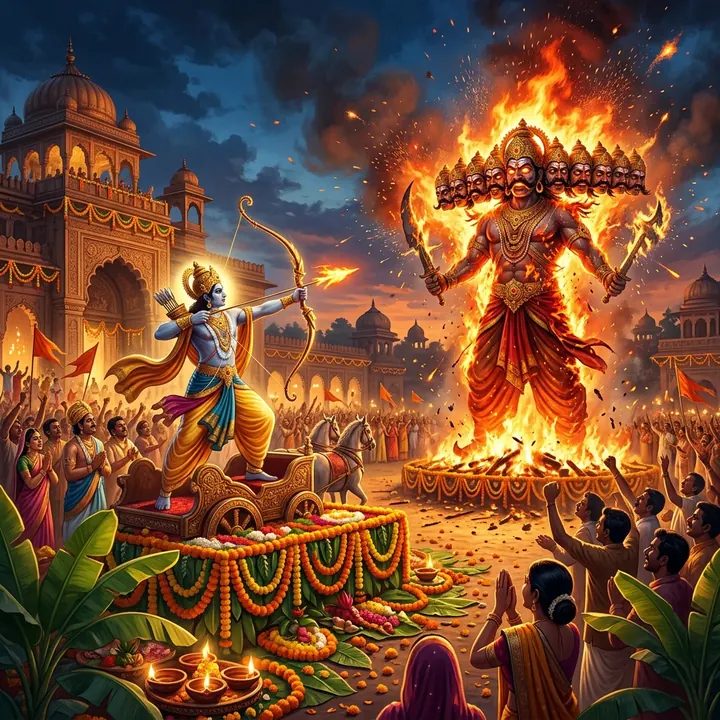
Dussehra, celebrated on the 10th day of Navratri, is one of India's most dramatic and visually powerful festivals. It commemorates two simultaneous mythological victories: Lord Rama's defeat of the demon king Ravana (from the Ramayana), and Goddess Durga's slaying of the buffalo demon Mahishasura (from the Devi Bhagavata). The name itself has dual meaning — 'Dasha-Hara' (remover of ten sins or ten directions) — symbolizing the absolute annihilation of ego, lust, greed, and all ten vices. Towering effigies of Ravana (and his brothers Kumbhakarna and Meghnad) stuffed with fireworks are dramatically burnt after Ram Lila performances, sending showers of sparks and smoke across the night sky.

History & Legends
The Great War Ends — Ram vs. Ravana
The Ramayana climaxes on Dussehra. After weeks of battle, Lord Rama — guided by the divine sage Agastya who taught him the 'Aditya Hridayam' (hymn to the Sun) — invoked the Brahmastra and fired it at the 10-headed demon king Ravana's navel, the source of his immortality. Ravana fell. Lanka was liberated. Sita was freed. The monkey army cheered. Ram's victory was not merely military — it was the victory of Dharma (cosmic order) over Adharma. The ten heads of Ravana symbolize the ten vices that every human must destroy: lust, anger, greed, attachment, pride, jealousy, selfishness, injustice, cruelty, and ego.
Durga's Victory — The Ninth Night and Tenth Morning
In eastern India, Dussehra follows nine days of Durga Puja celebrations. On the tenth day (Vijayadashami), the magnificent clay idols of Goddess Durga — worshipped in elaborately decorated pandals — are carried in grand processions to the river for immersion (Visarjan). The moment of immersion is deeply emotional: devotees bid farewell to the mother goddess who visits from Kailash every year. Women apply sindoor (vermilion) to each other's foreheads and to the goddess before immersion in the Sindoor Khela ritual — celebrating her victory and their own strength.
Shami Puja and the Weapons of War
In the Mahabharata, the Pandavas spent 12 years in exile and one year incognito (Agyatvas). Before their anonymity ended on Vijayadashami, they had hidden their weapons — the Gandiva bow, quivers, and swords — in a Shami tree near Virata's kingdom. On this day they reclaimed them and revealed themselves, marking the end of exile and the beginning of the final confrontation. This is why the Shami tree is worshipped on Dussehra, and leaves are exchanged as symbolic gold (sone-ki-patti) — wishing each other victory.
Spiritual Significance
Dussehra is both a military-origin festival (Kshatriya communities traditionally worshipped their weapons and animals on this day — called Shastra Puja and Ayudha Puja) and a deeply spiritual one. It marks the most auspicious day in the year for beginning new ventures — starting a business, purchasing a vehicle, beginning education, or launching any significant undertaking. The concept of Vijayadashami ('the tenth of victory') means whatever you begin on this day is blessed to succeed.

Regional Celebrations & Customs in Junagadh
Delhi — Ramlila Maidan
The Ramlila of Delhi, performed since the Mughal era, culminates with the burning of massive Ravana effigies. Some Ravana effigies in Delhi's Subhash Maidan and Dwarka reach 100+ feet. The Prime Minister attends the symbolic Ram Lila pageant at Ramlila Maidan annually.
Kullu Dussehra — Himachal Pradesh
Kullu's Dussehra is internationally famous and uniquely different. It begins when the rest of India ends its Dussehra — celebrated for 7 days starting Vijayadashami in the Kullu valley. Deities (devtas) from hundreds of surrounding villages are brought in decorated palanquins to bow before the chief deity Raghunathji. A massive rath yatra (chariot procession) draws hundreds of thousands of visitors.
Mysore Dasara — Karnataka
Mysore Dasara is one of India's most spectacular state festivals. The illuminated Mysore Palace (10,000 light bulbs) is visible for miles. A grand procession of 12 decorated elephants carries the goddess Chamundeshwari through the city. Classical dance performances, kabaddi tournaments, and a torchlight parade round off 10 days of celebration. Inscribed on the UNESCO Intangible Heritage list.
Bengal & Eastern India (Sindoor Khela)
Vijayadashami in Bengal follows 5 days of Durga Puja. Women in white saris with red borders play Sindoor Khela — applying vermilion to each other and to the goddess before she is carried to the river for immersion. The processions are an emotional, joyful farewell to Ma Durga.
Maharashtra & Konkan (Shami Puja)
Shami tree and Apta tree leaves are worshipped and exchanged as symbolic gold. Weapons and tools are cleaned and blessed (Shastra Puja / Ayudha Puja). Professional communities worship their tools — musicians clean instruments, mechanics worship vehicles, farmers worship their ploughs.
Junagadh Quick Facts
| Date | October (10th day after Navratri ends) |
|---|---|
| Tithi | Ashwin Shukla Dashami — 10th day of the bright fortnight of Ashwin month |
| Meaning | Victory of Good over Evil — Ram's triumph over Ravana / Durga's over Mahishasura |
| Location | Junagadh, Gujarat |
| Deities | Lord Rama Goddess Durga (Aparajita) Goddess Saraswati Shami tree (worshipped on this day) |
Share With Family & Friends
Share auspicious Dussehra muhurat timings in Junagadh on WhatsApp.
Share on WhatsAppNever Miss The Date
Add Dussehra to your device calendar for native notifications.