
Eid ul-Adha in Bhavnagar (2026)
eventJune / July (shifts ~11 days earlier each Gregorian year)location_onBhavnagar, GujaratAlso known as: Bakr Eid • Bakrid • Eid al-Adha • Festival of Sacrifice • Badi Eid
Vedic celebrations for Eid ul-Adha 2026 in Bhavnagar, Gujarat are determined by local sunrise, sunset, and Tithi timings calculated for geographical coordinates (21.76°N, 72.15°E).
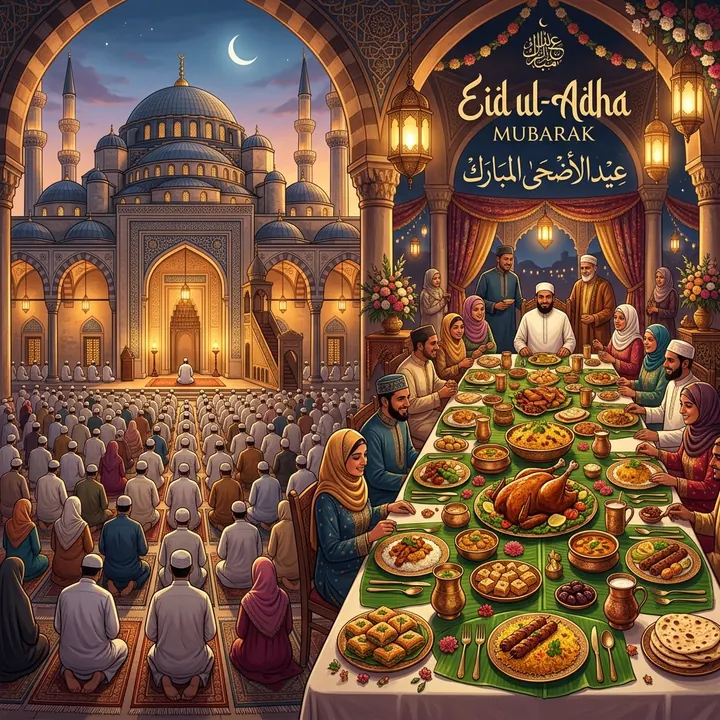
auto_awesomeThe Essence
Eid ul-Adha — the Greater Festival — commemorates the supreme act of submission and faith: Prophet Ibrahim's (Abraham's) willingness to sacrifice his son Ismail (Ishmael) at Allah's command. Just as Ibrahim was about to carry out the sacrifice, Allah replaced Ismail with a ram, sparing his life. This festival falls on the 10th of Dhul Hijjah — the last month of the Islamic calendar — and coincides with the conclusion of Hajj, the annual pilgrimage to Mecca which is the fifth pillar of Islam and the world's largest annual human gathering.

History & Legends
Ibrahim's Supreme Sacrifice
Prophet Ibrahim (AS) repeatedly dreamed that Allah was commanding him to sacrifice his beloved son Ismail. Recognizing it as divine will, he told his son. Ismail, a model of faith, responded: 'Father, do what you are commanded. You will find me, by the will of Allah, among the patient.' As Ibrahim laid Ismail down and was about to strike, the angel Jibreel arrived with Allah's message: 'O Ibrahim! You have fulfilled the vision!' A ram was substituted in Ismail's place. This event is referenced in the Quran (Surah As-Saffat, 37:102-107) and is considered the ultimate demonstration that nothing — not even one's most beloved — should come before devotion to God.
The Hajj Pilgrimage Connection
Eid ul-Adha falls at the peak of Hajj — the pilgrimage season. On the 9th of Dhul Hijjah, pilgrims stand on the plains of Arafat in the most important ritual of Hajj (Wuquf at Arafat), praying from afternoon till sunset. The next day — Eid ul-Adha — they perform the symbolic stoning of Shaitan at Mina, and the ritual animal sacrifice (Qurbani). The connection between Hajj and Ibrahim is complete: Ibrahim built the Kaaba in Mecca, and the Hajj pilgrimage commemorates the trials Ibrahim and his family endured in that very land.
Spiritual Significance
Eid ul-Adha teaches the profound Islamic value of Tawakkul (absolute trust in Allah) and Qurbani (sacrifice of ego, desires, and material attachment). The ritual animal slaughter (Qurbani) is not about the blood — the Quran explicitly says: 'It is not their meat nor their blood that reaches Allah. It is your piety that reaches Him.' The meat of the sacrificed animal is divided into thirds: one for the family, one for relatives and friends, and one for the poor — ensuring everyone participates in the feast.

Regional Celebrations & Customs in Bhavnagar
All of India (Universal Muslim Practice)
Eid prayer in the morning at the mosque or Eidgah. After prayers, the Qurbani (sacrifice of a goat, sheep, cow, or camel) is performed. The meat is distributed in three equal parts. Families feast on biryani, korma, seekh kebab, shami kebab, and haleem.
Hyderabad (Dum Biryani Capital)
Hyderabad's Bakrid celebrations are legendary for their food culture. The famous Hyderabadi dum biryani is prepared with freshly slaughtered meat. Pathar ka gosht, marag, and paya are traditional dishes. The old city (Purani Haveli area) comes alive.
Kashmir
Kashmiri Muslims celebrate with special wazwan (multi-course meat feast). Rogan Josh, Yakhni, Tabak Maaz, and Shab Deg are slow-cooked in traditional deg pots. The family feast is a grand occasion for reunion.
Mecca (Hajj — Global)
For the 2–3 million Hajj pilgrims, Eid ul-Adha at Mina near Mecca is the spiritual climax of their lives. After the stoning of Shaitan, they perform Qurbani, men shave their heads, and they complete the Tawaf (circumambulation of the Kaaba). The entire world's Muslim ummah is spiritually connected to this moment.
Key Rituals & Their Significance
| Ritual | Significance |
|---|---|
| Salat al-Eid (Morning Prayer) | Same as Eid ul-Fitr — congregational prayer followed by Khutbah. Marks the formal start of the day's celebrations. |
| Qurbani (Ritual Sacrifice) | Slaughter of a livestock animal in remembrance of Ibrahim's sacrifice. Mustahabb (recommended) for every financially able Muslim. One animal per household. |
| Meat Distribution (Thirds) | Dividing the sacrificed animal's meat into three equal portions — family, relatives, and the poor — is a built-in mechanism of wealth redistribution and community solidarity. |
| Takbeer chanting | 'Allahu Akbar, Allahu Akbar, La ilaha ill-Allah...' is chanted from the night before Eid through the days of sacrifice as a declaration of God's greatness. |
Bhavnagar Quick Facts
| Date | June / July (shifts ~11 days earlier each Gregorian year) |
|---|---|
| Tithi | 10th of Dhul Hijjah (12th and last month of the Islamic Hijri calendar) |
| Meaning | Festival of Sacrifice |
| Location | Bhavnagar, Gujarat |
| Deities | Allah (God in Islam) |
Share With Family & Friends
Share auspicious Eid ul-Adha muhurat timings in Bhavnagar on WhatsApp.
Share on WhatsAppNever Miss The Date
Add Eid ul-Adha to your device calendar for native notifications.