
Gandhi Jayanti in Mumbai (2026)
eventOctober 2 every yearlocation_onMumbai, MaharashtraAlso known as: Bapu's Birthday • International Day of Non-Violence • October 2
Vedic celebrations for Gandhi Jayanti 2026 in Mumbai, Maharashtra are determined by local sunrise, sunset, and Tithi timings calculated for geographical coordinates (19.08°N, 72.88°E).
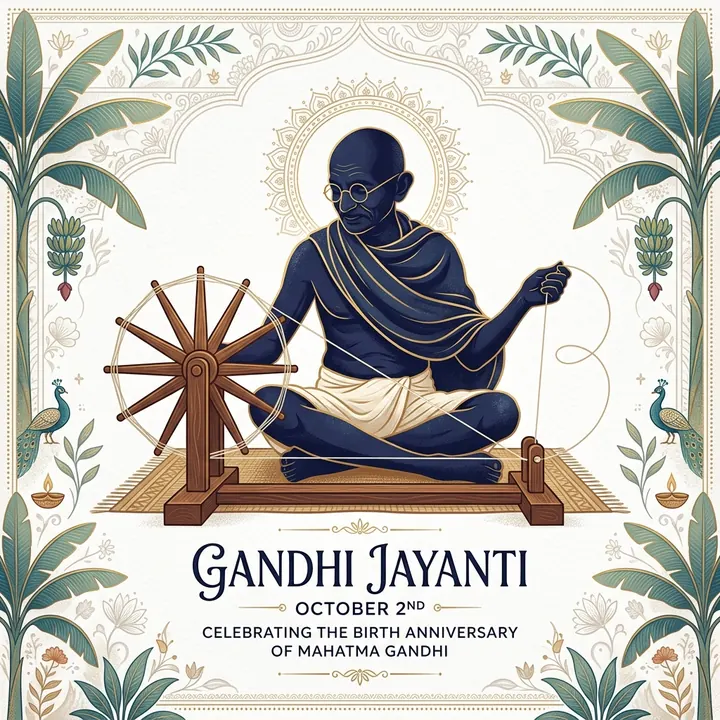
auto_awesomeThe Essence
Gandhi Jayanti marks the birth anniversary of Mohandas Karamchand Gandhi, born on October 2, 1869, in Porbandar, Gujarat. Universally known as 'Mahatma' (Great Soul) and 'Bapu' (Father), he led India's independence movement through the revolutionary philosophy of Ahimsa (non-violence) and Satyagraha (truth-force). His methods of peaceful civil disobedience influenced global liberation movements — from Martin Luther King Jr.'s Civil Rights Movement in the USA to Nelson Mandela's anti-apartheid struggle in South Africa. In 2007, the United Nations declared October 2 as the International Day of Non-Violence in his honour.

History & Legends
The Transformation in South Africa
Gandhi's philosophy did not begin in India. It was forged in South Africa, where he practiced law from 1893–1915. On June 7, 1893, he was thrown off a first-class train at Pietermaritzburg station solely because of his race despite having a valid first-class ticket. That night in the cold waiting room, he made a crucial decision: not to run away, but to fight injustice. Over 21 years in South Africa, he developed the concept of Satyagraha (clinging to truth), organized strikes against discriminatory laws, was imprisoned multiple times, and built the ashram model of community living that he would later recreate in India at Sabarmati and Sevagram.
The Dandi Salt March — 241 Miles, 80 Determined Feet
On March 12, 1930, Gandhi set out from Sabarmati Ashram in Ahmedabad with 78 followers on a 241-mile (388 km) march to the coastal village of Dandi, arriving on April 5. There, he picked up a lump of naturally occurring salt from the beach — an act of deliberate civil disobedience against the British Salt Tax, which made it illegal for Indians to produce or sell salt independently. This seemingly simple act ignited a nationwide civil disobedience movement. Within weeks, over 80,000 Indians were arrested. The Salt March captured the world's attention and became one of history's defining acts of non-violent resistance.
The Assassination and Eternal Legacy
On January 30, 1948 — just months after Independence — Gandhi was walking to his evening prayer meeting at Birla House in New Delhi when Nathuram Godse fired three bullets at close range. He died with 'Hey Ram' on his lips. His death shocked the world. Prime Minister Nehru said: 'The light has gone out of our lives.' His funeral procession in Delhi was attended by 2 million people. His life continues to inspire — Time magazine named him Person of the Century alongside Albert Einstein, and his spectacles, walking stick, and sandals are among the world's most recognizable symbols of moral authority.
Spiritual Significance
Gandhi Jayanti is a day for India and the world to reaffirm the values of non-violence, truth, simplicity, and service — principles that Gandhi lived and died by. It is observed with prayers, cleaning drives (inspired by Gandhi's own obsession with cleanliness and sanitation), spinning on the charkha (spinning wheel — his symbol of self-reliance), and homage at Raj Ghat — his samadhi (memorial) in New Delhi. The UN's designation makes it also a global day of reflection on peaceful conflict resolution.

Regional Celebrations & Customs in Mumbai
Raj Ghat, New Delhi (National Memorial)
The President, Prime Minister, and senior leaders pay tribute at Gandhi's memorial (Raj Ghat) with flower offerings and prayers. The ceremony is broadcast nationally. The Gandhi Smriti (Birla House, site of his assassination) also holds remembrance events.
Gujarat — Sabarmati Ashram & Porbandar
The Sabarmati Ashram in Ahmedabad — Gandhi's base for 13 years — holds dawn prayers and exhibitions. Porbandar, his birthplace, celebrates with cultural programs, exhibitions about his life, and a large local fair.
Schools & Colleges Nationwide
Essay competitions, debates, recitation of Gandhi's writings ('My Experiments with Truth', 'Hind Swaraj'), charkha spinning demonstrations, and skits about his life are common. Students visit Gandhian memorials and clean public spaces.
Swachh Bharat Abhiyan Events
Gandhi Jayanti is the official launch anniversary of the Swachh Bharat Abhiyan (Clean India Mission, 2014). Massive cleanliness drives are held across the country — in schools, government offices, railway stations, and public spaces — all in his memory.
Key Rituals & Their Significance
| Ritual | Significance |
|---|---|
| Prayer at Raj Ghat | Gandhi's samadhi (memorial), a simple black marble platform, is the centrepiece of national observance. 'Raghupati Raghava Raja Ram' — his favourite bhajan — is sung. |
| Charkha Spinning | Gandhi used the spinning wheel as a symbol of self-reliance, economic independence from British textiles, and the dignity of labour. Spinning on this day is an act of remembrance and principle. |
| Sarvodaya & Community Service | Gandhi's concept of 'Sarvodaya' (welfare of all) is commemorated through community service — feeding the poor, cleaning neighbourhoods, visiting orphanages. |
| Reading 'My Experiments with Truth' | His autobiography is considered one of the most important works of the 20th century — a candid, courageous account of his inner and outer journey. |
Mumbai Quick Facts
| Date | October 2 every year |
|---|---|
| Tithi | October 2 (fixed Gregorian date) |
| Meaning | Birth Anniversary of Mahatma Gandhi — Father of the Nation |
| Location | Mumbai, Maharashtra |
Share With Family & Friends
Share auspicious Gandhi Jayanti muhurat timings in Mumbai on WhatsApp.
Share on WhatsAppNever Miss The Date
Add Gandhi Jayanti to your device calendar for native notifications.