
Ganesh Chaturthi in Jaipur (2026)
eventAugust / September — 10-day festival (Chaturthi to Ananta Chaturdashi)location_onJaipur, RajasthanAlso known as: Vinayaka Chaturthi • Ganeshotsav • Vinayaka Chavithi • Pillayar Chaturthi
Vedic celebrations for Ganesh Chaturthi 2026 in Jaipur, Rajasthan are determined by local sunrise, sunset, and Tithi timings calculated for geographical coordinates (26.91°N, 75.79°E).
auto_awesomeThe Essence
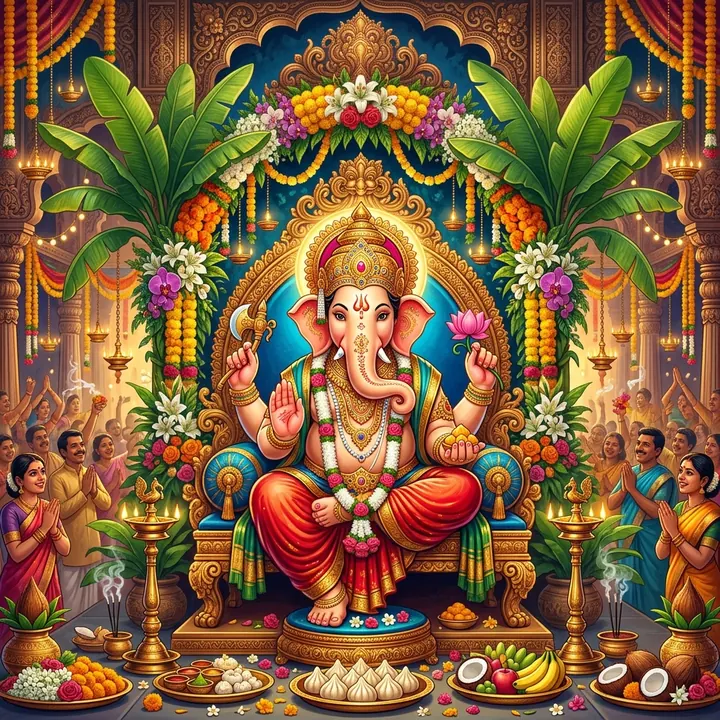
Ganesh Chaturthi is a 10-day festival celebrating the birth of Lord Ganesha — the elephant-headed son of Shiva and Parvati, worshipped as the remover of obstacles (Vighneshvara), lord of beginnings (Ganapati), and deity of intellect and wisdom. The festival involves the installation of beautifully crafted clay idols of Ganesha in homes and community pandals, elaborate daily pujas, and culminates on Ananta Chaturdashi (the 10th day) with the ceremonial immersion (Visarjan) of the idol in a water body. In Mumbai, the public celebrations pioneered by Bal Gangadhar Tilak in 1893 transformed Ganesh Chaturthi from a private Hindu ritual into India's most participatory public festival — a tradition of massive community pandals that endures to this day.

History & Legends
The Birth of Ganesha — Parvati's Creation
Goddess Parvati, before bathing, created a boy from the sandalwood paste (ubtan) she had applied to her body and breathed life into him, instructing him to guard the door and let no one enter. When Lord Shiva arrived and was blocked by this unknown boy, a confrontation ensued. Shiva's attendants could not defeat the child, who fought with immense bravery. Finally Shiva in anger severed the child's head. When Parvati learned what had happened she was inconsolable. Shiva, realizing the child was Parvati's own creation, sent his attendants north to find the head of the first living being they encountered sleeping with its head facing north. They found an elephant. Shiva attached the elephant's head to the child's body and restored his life. He then declared this child — Ganesha — to be worshipped first among all gods before any undertaking. This is why every Hindu puja begins with Ganesha.
Tilak's Transformation — From Private Puja to Public Festival
In 1893, Bal Gangadhar Tilak — freedom fighter, social reformer, and founder of the 'Swaraj is my birthright' movement — transformed the private household Ganesh Chaturthi puja into a large-scale public celebration. Under British rule, public gatherings were restricted. Tilak saw Ganesh Puja — transcending caste barriers since Ganesha is worshipped by all Hindus — as the perfect vehicle for community mobilization. He organized 10-day public festivals with discussions on independence, cultural programs, and sermons — all under the guise of religious celebration. The tradition he began in Pune in 1893 now manifests in the 165,000+ pandals across Mumbai alone every year.
The Race Around the Universe
Shiva and Parvati once challenged their sons: whoever circles the entire universe first will receive the divine fruit of knowledge. Kartikeya mounted his peacock and set off. Ganesha, who could not match his brother's speed, thought for a moment — then simply walked around his parents Shiva and Parvati. When asked why, he said: 'My parents are my entire universe. By circumambulating them I have gone around everything that exists.' Shiva and Parvati were moved to tears. Ganesha won the fruit. This story is the reason pradakshina (circumambulation of parents) is considered sacred — and why Ganesha is forever associated with wisdom over speed, intellect over brute force.
Spiritual Significance
Ganesh Chaturthi embodies the Hindu principle that before any beginning — of a day, a year, a business, a marriage, a journey, or a prayer — one must first invoke the Remover of Obstacles. Ganesha is the gate-keeper of all spiritual and material endeavours. The festival is also distinctly democratic: Ganesha's pandals serve free food to lakhs regardless of caste. In Maharashtra, the festival dissolved caste boundaries (Brahmins and non-Brahmins celebrating together) which is exactly why Tilak chose it as his vehicle for national unity.

Regional Celebrations & Customs in Jaipur
Mumbai (World's Largest Ganesh Festival)
Lalbaugcha Raja — the most powerful and visited Ganesh in the world — has a queue of 24–36 hours for darshan on peak days. Over 12 lakh people visit in 10 days. The idol grants singular wishes. Other famous Mumbai Ganeshas: GSB Seva Mandal (world's most valuable idol), Khetwadi Ganesh. Mumbai's Visarjan procession on Day 10 brings the city to a standstill.
Pune (Cultural Capital of Ganeshotsav)
Pune has the historic Manacha Ganapatas — 5 most honoured Ganeshas in order: Kasba Ganapati, Tambdi Jogeshwari, Guruji Talim, Tambat Ali, Kesariwada. The procession order of these five is a civic matter of great prestige. Dagdusheth Halwai Ganapati attracts celebrities, politicians, and lakhs of devotees. Pune's festival is known for cultural competitions, theatre, and art exhibitions.
Hyderabad (Balapur Ganesh)
The Balapur Ganesh auction — where the first modak offered to the deity is auctioned publicly — is a major community event. High bidders compete on the premise that the blessed modak brings prosperity. In 2023, the modak was auctioned for ₹24.3 lakh. Hyderabad's processions on Ganesh Nimajjanam (Visarjan) day draw millions.
Home Puja (Pan-India)
In homes, clay idols of 1-day, 3-day, or 5-day installation are worshipped with daily aarti, Ganesh Atharvashirsha recitation, and offerings of modak. The home puja connects families across generations — grandparents teaching grandchildren the 108 names of Ganesha (Ganesha Ashtottara).
The 5 Days of Celebration
- fiber_manual_recordDay 1 — Sthapana (Installation)The clay Ganesha idol is installed in homes or pandals with the Pranapratishtha ritual (invocation of life into the idol). Puja begins with 16-step ritual (Shodashopachara): flowers, fruits, modak (coconut-jaggery sweet — Ganesha's favourite), durva grass (specially sacred to Ganesha). The idol is worshipped at dawn and dusk daily.
- fiber_manual_recordDays 2–4 — Daily WorshipMorning and evening aarti with Ganesh Atharvashirsha (a powerful Upanishad text dedicated to Ganesha) chanted. Cultural programs — music, dance, sports — are organized by community pandals. Prasad of modak, laddoo, and seasonal fruits distributed free to all visitors.
- fiber_manual_recordDays 5–7 — Madhyama Visarjan optionSmall-scale idols installed for 1.5, 3, or 5 days are immersed on these days. The main 10-day community pujas continue building in intensity and grandeur.
- fiber_manual_recordDays 8–9 — Peak CelebrationsMaharashtra's major pandals — Lalbaugcha Raja, Dagdusheth Halwai (Pune), Kasba Ganapati (Pune's manacha — city's most honoured) — see queues of 12–24 hours. Ministers and celebrities visit. Live music and cultural events run 24 hours.
- fiber_manual_recordDay 10 — Ananta Chaturdashi (Visarjan)The climactic farewell. Community idols are carried in enormous processions through the city, with drums, music, and dancing devotees, to the sea, river, or lake for immersion. Mumbai's Ganesh Visarjan at Juhu, Girgaum, and Marina beaches sees lakhs of people. The cry 'Ganapati Bappa Morya! Purchya Varshi Lavkar Ya!' (Ganesha, come early next year!) fills the air.
Key Rituals & Their Significance
| Ritual | Significance |
|---|---|
| Pranapratishtha | Ritual invocation of the deity's presence into the clay idol — making it a living representation of Ganesha for the duration of the festival. Performed by priests on Day 1. |
| Modak Offering | Modak (steamed rice-flour dumpling with coconut-jaggery filling) is Ganesha's favourite food. 21 modaks are traditionally offered. The shape is said to represent the shape of the universe. |
| Ganesh Atharvashirsha | A Vedic Upanishad text specifically about Ganesha's cosmic nature, chanted 21 times or 108 times during the festival. Its recitation is believed to remove all obstacles. |
| Visarjan (Immersion) | The idol is returned to the five elements (water, earth). 'Ganapati Bappa Morya, Purchya Varshi Lavkar Ya!' — the farewell cry that invites the god back the following year. Now eco-friendly clay idols and artificial ponds are widely promoted. |
Jaipur Quick Facts
| Date | August / September — 10-day festival (Chaturthi to Ananta Chaturdashi) |
|---|---|
| Tithi | Bhadrapada Shukla Chaturthi — 4th day of the bright fortnight of Bhadrapada month |
| Meaning | Birth of Lord Ganesha — Remover of Obstacles, Lord of Beginnings |
| Location | Jaipur, Rajasthan |
| Deities | Lord Ganesha (Ganapati, Vinayaka, Vighneshvara) Goddess Parvati (Ganesha's mother) Lord Shiva (Ganesha's father) |
Share With Family & Friends
Share auspicious Ganesh Chaturthi muhurat timings in Jaipur on WhatsApp.
Share on WhatsAppNever Miss The Date
Add Ganesh Chaturthi to your device calendar for native notifications.