
Holi in Ahmedabad (2026)
eventMarch (Full Moon Day)location_onAhmedabad, GujaratAlso known as: Festival of Colours • Festival of Spring • Dhulwad • Phagwah
Vedic celebrations for Holi 2026 in Ahmedabad, Gujarat are determined by local sunrise, sunset, and Tithi timings calculated for geographical coordinates (23.02°N, 72.57°E).
auto_awesomeThe Essence
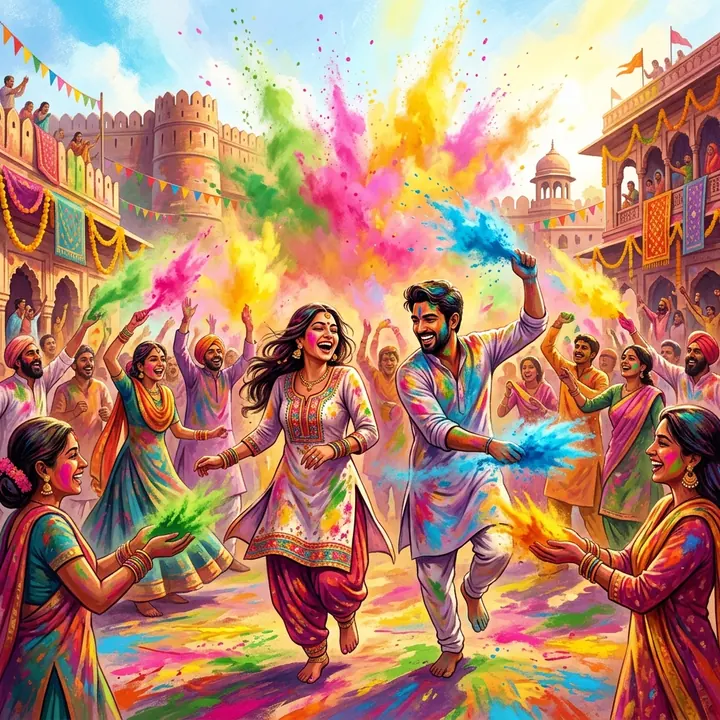
Holi is the vibrant Hindu festival of colours and spring, celebrated with joyous abandon across India and wherever Indians gather worldwide. It marks the end of winter and the arrival of the harvest season of spring, commencing on the evening of Purnima (full moon day) in the Hindu calendar month of Phalgun. The festival is a triumph of love, devotion, and the eternal victory of good over evil. For two days, streets transform into rivers of colour as people drench each other in gulal powder and water, erasing social divisions in a shared celebration of life.

History & Legends
Prahlad and the Demon Holika
The most popular legend behind Holi is the story of the young devotee Prahlad and the demoness Holika. Hiranyakashipu, a demon king, believed himself to be immortal and forbade the worship of any god. However, his son Prahlad was an ardent devotee of Lord Vishnu and refused to stop his prayers. Frustrated, the king ordered his sister Holika — who had a divine shawl that made her immune to fire — to sit in a bonfire with Prahlad on her lap. By Lord Vishnu's grace, the shawl flew from Holika and covered Prahlad instead. Holika perished in the flames, and Prahlad emerged unharmed. The bonfire event is commemorated as 'Holika Dahan' on the night before Holi, symbolizing the victory of devotion and good over arrogance and evil.
The Divine Love of Krishna and Radha
In the tradition of Braj (Mathura-Vrindavan), Holi is deeply associated with the playful and divine love of Lord Krishna and Radha. As a child, Krishna was famously envious of Radha's fair complexion, since he himself was dark-skinned. His mother Yashoda playfully suggested he apply colour on Radha's face to make her his own colour. This tender act of applying colours on a beloved became the cornerstone of the Holi tradition. In Vrindavan and Mathura, Holi is celebrated for over a week and is considered the most spectacular in the entire world — a living re-enactment of divine love.
Spiritual Significance
Holi carries profound spiritual significance beyond its festive exterior. The burning of Holika on the night before Holi — 'Holika Dahan' — is a ritual of collective purification. Devotees circumambulate the bonfire, and it is believed that the heat of the flames destroys negative energies, ill-will, grudges, and impurities from the mind and soul. The next morning's play with colours is the great equalizer — on Holi, social hierarchies dissolve. Rich and poor, young and old, men and women all play together, wearing the same colours, signifying unity, forgiveness, brotherhood, and a fresh start as spring renews the earth.

Regional Celebrations & Customs in Ahmedabad
Vrindavan & Mathura (Braj)
The most legendary Holi on earth. Celebrated for over a week with the famous 'Lathmar Holi' of Barsana, where women playfully beat men with wooden sticks. The Phoolon wali Holi (with flower petals) and devout Holika Dahan ceremonies make this a sacred pilgrimage for Holi.
North India
Holika Dahan bonfire on the eve, followed by Rangwali Holi (playing with gulal powder and water guns). People sing folk songs, eat Gujiya, Malpua, Dahi Bhalle, and drink Thandai — sometimes laced with bhang (cannabis) in the tradition of Shiva's festival.
Maharashtra (Shimga)
Known locally as 'Shimga', celebrated over five days. A massive community bonfire is lit. People throw dried cow-dung cakes, coconuts, and sugarcane into the fire. Known for energetic performances of Holi songs called 'Holi Patya' and village processions.
West Bengal (Dol Purnima)
Called 'Dol Purnima' or 'Dol Jatra'. Idols of Radha and Krishna are placed in decorated swings (dols) and carried in grand processions through streets. Celebrated with classical music and Rabindrasangeet; dry abir (coloured powder) is used rather than wet colours.
South India (Kamadahana)
Celebrated in Karnataka and parts of Tamil Nadu as 'Kamadahana' — commemorating the burning of Kamadeva (the god of love) by Lord Shiva. It is a more devotional festival here, focused on prayer, rituals, and mild colour play with family.
Ahmedabad Quick Facts
| Date | March (Full Moon Day) |
|---|---|
| Tithi | Purnima (Full Moon) of the Hindu month of Phalgun |
| Meaning | Colour, Spring & New Beginnings |
| Location | Ahmedabad, Gujarat |
| Deities | Lord Krishna Radha Rani Prahlad |
Share With Family & Friends
Share auspicious Holi muhurat timings in Ahmedabad on WhatsApp.
Share on WhatsAppNever Miss The Date
Add Holi to your device calendar for native notifications.