
Maha Shivaratri in Patna (2026)
eventFebruary / March (one night before New Moon)location_onPatna, BiharAlso known as: Great Night of Shiva • Shivaratri
Vedic celebrations for Maha Shivaratri 2026 in Patna, Bihar are determined by local sunrise, sunset, and Tithi timings calculated for geographical coordinates (25.59°N, 85.14°E).
auto_awesomeThe Essence
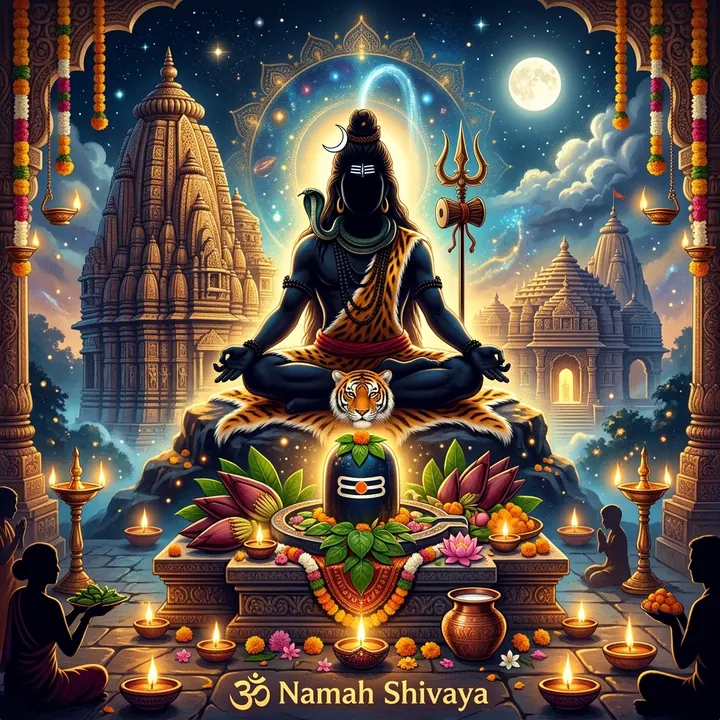
Maha Shivaratri is the most sacred night dedicated to Lord Shiva, the supreme deity of Hindu Shaivism. Unlike most Hindu festivals celebrated with colour, music, and festivity during the day, Maha Shivaratri is a night of solemn fasting, meditation, and all-night vigil (Jaagaran) in honour of Shiva. The word 'Shivaratri' literally means 'the night of Shiva'. Devotees believe that on this night, Lord Shiva performed the Tandava — the cosmic dance of creation, preservation, and destruction. It is a night when the planetary positions are believed to powerfully enhance human spiritual energy.

History & Legends
The Wedding of Shiva and Parvati
The most cherished legend holds that Maha Shivaratri is the divine wedding anniversary of Lord Shiva and Goddess Parvati. After Sati (Shiva's first wife) immolated herself, she was reborn as Parvati. She performed rigorous penance for thousands of years to win Shiva back as her husband. On the Chaturdashi (14th night) of the dark fortnight in Phalgun, their celestial wedding took place. This is why Maha Shivaratri is also considered very auspicious for unmarried women — they fast and pray to Lord Shiva for a good husband like him.
The Emergence of the Jyotirlinga
The Shiva Purana recounts that once Brahma and Vishnu were arguing about who was the supreme deity. Suddenly, a mysterious pillar of light (Jyotirlinga) appeared, stretching infinitely in both directions. Brahma flew upward as a swan to find the top; Vishnu dug down as a boar to find the base. Neither could find an end. Realising his limitlessness, both accepted Shiva as the supreme force of the universe. The apparition of the Jyotirlinga is said to have occurred on the night of Maha Shivaratri.
The Hunter and Shiva
A famous story from the Puranas tells of a hunter who accidentally fasted all day while hunting and, perched on a Bilwa tree at night, absent-mindedly dropped leaves on a Shiva Linga below. As dawn broke, he unknowingly had performed an all-night vigil and offered Bilwa leaves, pleasing Shiva immensely. At death, when Yamadoots came for him, Shiva's attendants arrived and took him to Kailash instead, since his accidental worship had purified him completely.
Spiritual Significance
Maha Shivaratri is a festival of inner awakening. In yogic tradition, this night is the darkest — when the lunar energy is most absent — creating conditions ideal for deep meditation. Shiva is 'Adiyogi', the first and greatest of all yogis. His Tandava dance symbolizes that the entire cosmos is a dance of energy — creation and dissolution in eternal rhythm. Fasting through the night and chanting the Panchakshara Mantra ('Om Namah Shivaya') is believed to dissolve karmic residue and accelerate spiritual progress. Visiting the 12 Jyotirlingas (sacred Shiva temples) is the ultimate pilgrimage goal.

Regional Celebrations & Customs in Patna
All of India
The night consists of four 'Praharas' (3-hour watches). In each prahara, Shiva is given a ritual bath (abhishek) with milk, honey, rose water, yoghurt, and Ganga water, followed by offering of Bilwa (Bael) leaves and flowers. The all-night vigil — Jaagaran — includes bhajans and chanting of 'Om Namah Shivaya'.
Varanasi (Kashi Vishwanath)
The holiest Shivaratri experience. The Kashi Vishwanath temple sees millions of devotees. Night-long kirtans echo through the ghats of the Ganga. A grand procession of Lord Shiva as a bridegroom is taken through the city.
Mandi, Himachal Pradesh
Called the 'Kullu Dussehra of Winter'. Over 200 deities (devatas) from surrounding villages are brought to Mandi town in a grand week-long fair called 'Shivaratri Fair'. The deity idols are placed before the Bhootnath temple in a divine assembly.
Maharashtra
The Trimbakeshwar and Bhimashankar Jyotirlingas become the centre of grand celebrations. Special abhisheks, Rudrabhishek rituals, and Laghurudra yagnas are performed.
South India
Temples remain open all night. At the Chidambaram Nataraja temple in Tamil Nadu, the dancing form of Shiva (Nataraja) is venerated in a special late-night service. The Menakshi Sundareshwarar temple in Madurai holds elaborate processions.
Patna Quick Facts
| Date | February / March (one night before New Moon) |
|---|---|
| Tithi | Krishna Paksha Chaturdashi of Phalgun month (14th night of the waning moon) |
| Meaning | The Great Night of Lord Shiva |
| Location | Patna, Bihar |
| Deities | Lord Shiva (Mahadeva) Goddess Parvati |
Share With Family & Friends
Share auspicious Maha Shivaratri muhurat timings in Patna on WhatsApp.
Share on WhatsAppNever Miss The Date
Add Maha Shivaratri to your device calendar for native notifications.