
Pongal in Jamnagar (2026)
eventJanuary 14 – 17 (4 days)location_onJamnagar, GujaratAlso known as: Thai Pongal • Sankaranthi (Telugu) • Uttarayan (Gujarat)
Vedic celebrations for Pongal 2026 in Jamnagar, Gujarat are determined by local sunrise, sunset, and Tithi timings calculated for geographical coordinates (22.47°N, 70.06°E).
auto_awesomeThe Essence
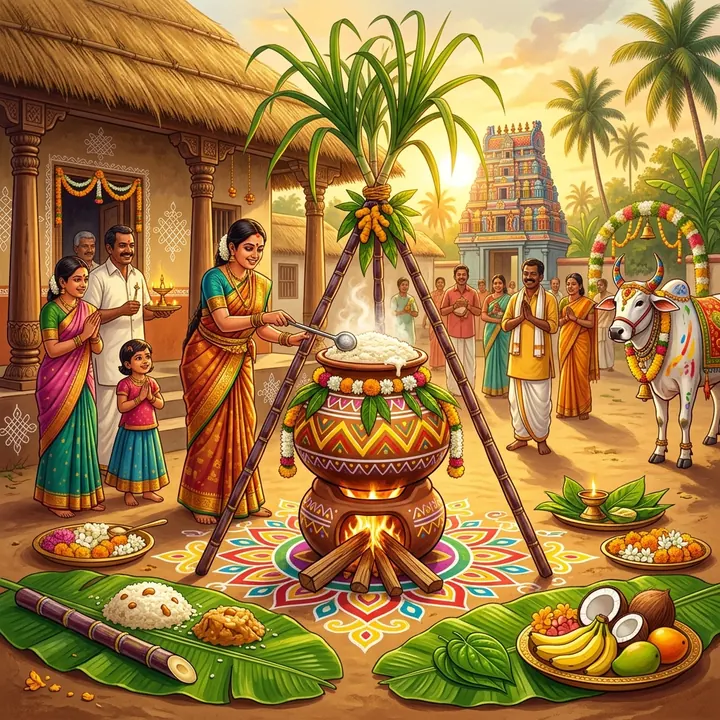
Pongal is the most important harvest festival of Tamil Nadu and is celebrated over four days in mid-January when the winter crop — rice, sugarcane, and turmeric — is reaped. It marks gratitude to the Sun, the earth, cattle, and the rains for enabling a bountiful harvest. The name 'Pongal' refers to the traditional dish of sweet rice cooked in a new clay pot which is allowed to boil over — the overflowing symbolizes abundance and prosperity overflowing into one's life. Pongal is deeply rooted in agrarian culture and predates most of the pan-Indian festivals, going back at least 2,000 years.

History & Legends
Lord Shiva Sends the Bull Nandi to Earth
The most popular Pongal legend involves Lord Shiva sending his bull Nandi to earth with a message for humans: 'Take an oil bath every day and eat only once a month.' Nandi, however, confused the message and announced to the earthlings: 'Eat every day and take an oil bath once a month.' Shiva was displeased with this error and banished Nandi to earth permanently to help mankind plough the fields and produce enough food to eat every day. This legend explains why bulls are central to Tamil agriculture and why Mattu Pongal honours them.
Indra's Arrogance and Indra Vizha
Historically, the first day of Pongal season was associated with 'Indra Vizha' — a festival honouring Indra for rain. When the Tamil classical literature (Sangam period) records this festival, it was an occasion for celebration of the rains. Over centuries, as Shaivite and Vaishnavite traditions emerged, the focus shifted to Surya Dev. Today, Bhogi (the first day) is linked to the Lord Indra tradition of renewal.
Spiritual Significance
Pongal is fundamentally a festival of gratitude — to the Sun for light and warmth, to rain for water, to the earth for fertility, and to the cattle for their toil. Unlike many festivals associated with temple rituals, Pongal is largely a domestic festival celebrated at home, in courtyards, and in the fields. It connects Tamil people deeply to their rural agrarian roots and reinforces the value of nature's cycles.

Regional Celebrations & Customs in Jamnagar
Tamil Nadu (Heartland)
Homes are decorated with freshly drawn kolam (rice flour designs) at every doorstep. Sugarcane pieces and banana plants are placed at entrances. Women wear traditional Kanjivaram silk sarees. The pot-boiling ritual is performed in the open courtyard facing the sun.
Tamil Diaspora (Malaysia, Singapore, Sri Lanka)
Large community celebrations are organized. In Malaysia, Pongal is a public holiday. Cultural programmes, traditional games, and communal Pongal cooking events are held.
Andhra Pradesh & Telangana (Sankranthi)
Known as 'Makara Sankranthi'. The 3-day festival includes Bhogi bonfires, kite flying, exchange of sweets, 'Gobbemmalu' (dung cake decorations), and thanksgiving rituals similar to Thai Pongal.
The 5 Days of Celebration
- fiber_manual_recordDay 1: Bhogi PongalOld and unwanted items are discarded and burned in a bonfire at dawn, symbolizing the release of the past. Families clean and whitewash homes, draw kolam (rangoli) at the entrance.
- fiber_manual_recordDay 2: Thai Pongal (Main Day)The centrepiece of the festival. A fresh clay pot is decorated with turmeric leaves. Rice and milk are boiled in it until it overflows ('Pongalo Pongal!' is shouted). The dish is offered to Surya Dev first.
- fiber_manual_recordDay 3: Mattu PongalDay of thanksgiving to cattle — the backbone of Indian agrarian life. Cows and bulls are bathed, decorated with garlands, painted horns, and bells, and worshipped.
- fiber_manual_recordDay 4: Kaanum PongalFamily outing day. Sisters pray for their brothers' well-being (similar to Bhai Dooj). Leftover food from the previous day is laid out on turmeric leaves as an offering to birds.
Key Rituals & Their Significance
| Ritual | Significance |
|---|---|
| Kolam (Rangoli) | Intricate rice-flour geometric patterns drawn at every home entrance to welcome Goddess Lakshmi and ward off evil spirits. |
| Pongal Pot Boiling | The primary ritual — boiling fresh harvest rice in new clay pot with milk and jaggery until it overflows, offered to Surya Dev. |
| Sugarcane Offering | Freshly harvested sugarcane is offered and eaten. Its sweetness symbolizes the sweetness of life and the harvest's reward. |
| Mattu Pongal (Cattle worship) | Bulls and cows are a farmer's most valuable asset. Honouring them expresses gratitude for their tireless service to agriculture. |
Jamnagar Quick Facts
| Date | January 14 – 17 (4 days) |
|---|---|
| Tithi | Thai 1st in Tamil calendar (Solar transit of Sun into Capricorn) |
| Meaning | Overflow / To Boil Over — symbolizing abundance |
| Location | Jamnagar, Gujarat |
| Deities | Surya Dev (Sun God) Indra (Rain God) Pongal (harvest deity) Cattle |
Share With Family & Friends
Share auspicious Pongal muhurat timings in Jamnagar on WhatsApp.
Share on WhatsAppNever Miss The Date
Add Pongal to your device calendar for native notifications.