
Raksha Bandhan in Gandhinagar (2026)
eventJuly / August (full moon of Shravan month)location_onGandhinagar, GujaratAlso known as: Rakhi • Raksha Bandhan • Saluno • Silono • Rakhi Purnima
Vedic celebrations for Raksha Bandhan 2026 in Gandhinagar, Gujarat are determined by local sunrise, sunset, and Tithi timings calculated for geographical coordinates (23.22°N, 72.64°E).
auto_awesomeThe Essence
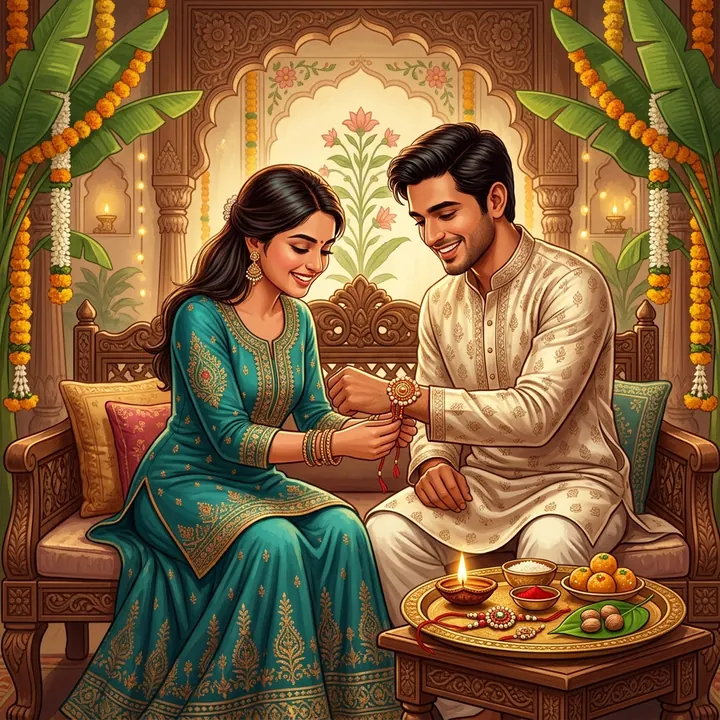
Raksha Bandhan is India's most heartfelt sibling festival — a celebration of the bond between a sister and her brother. On this full moon day of Shravan, a sister ties a rakhi (a sacred thread, often elaborately decorated) on her brother's wrist, praying for his long life and well-being. The brother in turn gives a gift and pledges his protection. The ritual is simple; its meaning is ancient and profound. 'Raksha' means protection; 'Bandhan' means bond — the sacred thread symbolizes a promise of care that transcends physical distance. Over centuries the festival has evolved well beyond blood siblings — a rakhi can be tied to any person whose protection one seeks or whose courage one honours.

History & Legends
Draupadi and Krishna — The Original Rakhi
The Mahabharata records arguably the most famous rakhi bond in mythology. When Lord Krishna accidentally cut his finger during the Shishupala war, Draupadi tore a strip from her sari and tied it around his wound to stop the bleeding. Krishna was deeply moved. He told her: 'This simple bandage of love creates a debt I will spend my life repaying.' Years later, when Draupadi was being humiliated in the Kuru court, Krishna's divine intervention — endlessly lengthening her sari — was his fulfillment of that promise. Their bond is the archetype of Raksha Bandhan: the protection given in return for the faith and care of a sisterly heart.
Rani Karnavati and Emperor Humayun
One of history's most remarkable rakhis was sent in 1535 CE. When Bahadur Shah of Gujarat threatened to attack Mewar, the widowed Rajput queen Karnavati sent a rakhi to the Mughal Emperor Humayun — a Muslim king — appealing to a brother's duty of protection. Humayun was so moved by this honour that he immediately mobilized his forces and marched toward Mewar, though he arrived too late to save her. The story has become a symbol of how Raksha Bandhan transcended religion and community — the thread of a rakhi could create sacred kinship between any two human beings.
Yama and Yamuna — The Divine Siblings
The Skanda Purana contains a beautiful story: The river goddess Yamuna tied a rakhi on her brother Yama (the god of death) and prayed for his welfare. Yama was so touched that he declared: 'Any brother who receives his sister's rakhi on this day shall be freed from the fear of death.' This blessing — that a brother protected by his sister's prayer gains a form of divine immunity — is considered the cosmic origin of the Shravan Purnima rakhi tradition.
Spiritual Significance
Raksha Bandhan enshrines a relationship that India's classical literature holds second only to parents: the bond between brother and sister. It recognizes the sister as the one who sees her brother most clearly — celebrating his strengths, overlooking his flaws, praying for his safety — and the brother as the one who pledges to stand for her honour unconditionally. In modern India the festival has beautifully expanded: sisters tie rakhis to female friends, citizens tie rakhis to trees (Van Mahotsav Raksha Bandhan), soldiers at borders receive rakhis from strangers — making the thread not just a family bond but a national one.

Regional Celebrations & Customs in Gandhinagar
North India (Uttar Pradesh, Rajasthan, Haryana)
Sisters prepare a puja thali with rakhi, roli (red turmeric paste), rice grains, diya, and sweets. The brother sits and the sister performs aarti, applies tilak on his forehead, ties the rakhi on his right wrist, and feeds him sweets. He gives a gift (Eidi equivalent — cash or present). The family meal marks the conclusion.
Maharashtra (Nariyal Purnima)
Raksha Bandhan coincides with Nariyal Purnima (Coconut Full Moon) — the day when the sea is considered calm after the monsoon and fishermen return to the ocean. Fishermen and coconut traders offer coconuts to the sea (Varuna the sea god), and the rakhi tradition is observed alongside this coastal celebration.
West Bengal (Jhulan Yatra)
In Bengal this full moon is Jhulan Purnima — a celebration of the divine love of Radha and Krishna. Decorated swings (jhulans) are set up in temples where Radha-Krishna idols are ceremonially swung. Raksha Bandhan is observed but embedded within this romantic-devotional Vaishnava festival.
Armed Forces & Border Traditions
Raksha Bandhan has a special emotion at India's borders. Sisters, wives, and strangers send rakhis to soldiers. Some army units are entirely covered in thousands of rakhis tied on their vehicles and equipment. This national expression of the protective brotherhood makes the festival larger than biology.
Key Rituals & Their Significance
| Ritual | Significance |
|---|---|
| Puja Thali preparation | The sacred tray holds the rakhi, roli (red-yellow turmeric-kumkum paste), rice grains (akshata), lit diya, and sweets — each item with symbolic meaning for protection, prosperity, and divine blessings. |
| Tilak and Aarti | The sister draws a tilak on the brother's forehead and performs aarti (circular light offering) — protecting him from evil eye (nazar) and praying for his long life. |
| Tying the Rakhi | Tied on the right wrist with a prayer. The thread (now often silk, gold, or silver-threaded) creates a sacred bond. The act is performed facing east or north in an auspicious direction. |
| Gift Exchange | The brother gives his sister a gift — traditionally cash, which gave her financial agency. Today gifts range from jewelry to gadgets to experiences. The gift symbolizes the brother's pledge of support. |
Gandhinagar Quick Facts
| Date | July / August (full moon of Shravan month) |
|---|---|
| Tithi | Shravan Purnima — Full moon day of Shravan month |
| Meaning | Bond of Protection — the sacred thread of love, protection, and gratitude between siblings |
| Location | Gandhinagar, Gujarat |
| Deities | Lord Vishnu (Shravana Purnima is sacred to Vishnu) Goddess Lakshmi Yama and Yamuna (the divine sibling pair) |
Share With Family & Friends
Share auspicious Raksha Bandhan muhurat timings in Gandhinagar on WhatsApp.
Share on WhatsAppNever Miss The Date
Add Raksha Bandhan to your device calendar for native notifications.