
Vaisakhi
eventApril 13 or 14 every yearAlso known as: Baisakhi • Vaishakhi • Mesadi (Kashmir) • Pana Sankranti (Odisha)
auto_awesomeThe Essence
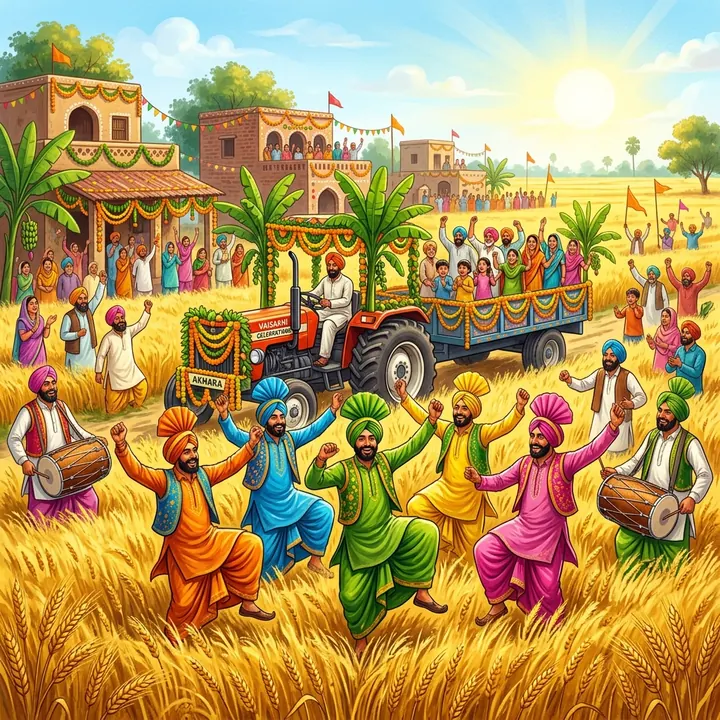
Vaisakhi (or Baisakhi) is one of the most important festivals in Punjab, celebrated both as the spring harvest festival and as the founding anniversary of the Khalsa Panth by Guru Gobind Singh Ji on April 13, 1699. On that historic day at Anandpur Sahib, Guru Gobind Singh Ji called the Sangat (congregation), drew his sword, and asked if anyone was willing to give his head for his faith. Five men — the Panj Piaras (Five Beloved Ones) — stepped forward. He initiated them with Amrit (holy water) and founded the Khalsa — an order of baptised Sikhs committed to living by the highest principles of courage, equality, and service.

History & Legends
The Birth of the Khalsa (1699)
On Vaisakhi 1699, Guru Gobind Singh Ji convened an extraordinary gathering at Anandpur Sahib. In front of thousands, he drew his sword and requested someone willing to sacrifice their life for God and the faith. After three calls, Daya Ram (later Daya Singh) stepped forward. The Guru took him inside a tent and emerged with a blood-soaked sword. This was repeated four more times — Dharam Das, Himmat Rai, Mohkam Chand, and Sahib Chand came forward one by one. All five emerged alive, transformed, baptised as the first five Khalsa. They were given the name 'Singh' (lion) for men and 'Kaur' (princess) for women, and given the Five Ks (Panj Kakaars).
Jallianwala Bagh Massacre (1919)
Vaisakhi 1919 became a dark day in Indian history. A large crowd had gathered at Jallianwala Bagh in Amritsar to celebrate Vaisakhi when General Reginald Dyer ordered British Indian Army troops to fire on the unarmed crowd without warning. The massacre killed at least 379 people officially (with estimates far higher) and wounded over 1,200. The tragedy sparked a national outrage, galvanising the Indian independence movement. Jallianwala Bagh is now a national memorial.
Spiritual Significance
Vaisakhi carries a dual significance — agrarian and spiritual. For farmers, it marks the ripening of the winter wheat crop (Rabi harvest) and an occasion of great joy, starting of the harvesting season. For Sikhs worldwide, it is the most sacred anniversary — the Khalsa Sajna Diwas (Khalsa Foundation Day) — a time to renew their commitment to the Sikh faith. Amrit Sanchars (baptism ceremonies) are held in Gurudwaras around the world as Sikhs take Amrit on this auspicious day.

How It Is Celebrated
Punjab — Amritsar & Anandpur Sahib
The grandest Vaisakhi celebrations on earth. The Golden Temple (Harmandir Sahib) in Amritsar is the focal point — a sea of devotees arrives for ardas (prayers) and langar (community meal). Anandpur Sahib holds the grand Hola Mohalla festival with Nihang Sikh displays of martial arts (Gatka) and horsemanship.
Haryana & Punjab (Harvest Festival)
Farmers perform special pujas to thank God for the harvest. Bhangra (energetic Punjabi folk dance) and Gidda are performed at fairs and melas. Saag (mustard greens), Makki di Roti, and Lassi are the traditional foods.
Sikh Diaspora Worldwide
Vaisakhi is celebrated by Sikh communities in UK, Canada, USA, and Australia with grand Nagar Kirtan (street processions) carrying the Guru Granth Sahib through city streets, accompanied by thousands in traditional dress.
Kashmir (Mesadi)
The Kashmiri New Year begins on this day, called 'Navreh' or 'Mesadi'. Families wake before sunrise to look at a thali filled with auspicious objects, which is believed to set the mood for the year ahead.
Quick Facts
| Date | April 13 or 14 every year |
|---|---|
| Tithi | Solar transit of Sun into Aries (Mesha Sankranti) |
| Meaning | Harvest Festival & Birth of the Khalsa |
| Deities | Guru Gobind Singh Ji Waheguru (Sikh God) Surya Dev |
Never Miss The Date
Add Vaisakhi to your device calendar for native notifications.